Showing posts with label sylvia plath. Show all posts

Tuesday, 24 May 2011

the importance of war

This is an opinion piece for American History & Culture class. I wrote this during a bus transit in Martinez on my way to Santa Rosa last Wednesday. I was a bit disoriented while doing it, but I guessed it turned out okay.

***

I saw James Cameron’s Avatar on DVD last night. Last year, when it was being played at theatres in my hometown, I went to see it not once, not twice, not three times, but six times: three times in 3D, the rest in 2D. When I watched it last year, I was captivated by the visuals, the film-making technology, and the language the Na’vi (the indigenous people of the Pandora) spoke, and of course, Sigourney Weaver (I just love her in all her movies, especially the Alien saga).

Last night, however, I looked at the movie in another perspective: the war. There was a big battle between the humans and the Na’vi. The humans wanted to colonize Pandora and take very valuable resource aptly called the Unobtanium. The Na’vi could not care less about this Unobtanium, as they were more interested in preserving their tradition, the nature, and their world. Battle ensued, a great, big, battle. The humans had the more advanced technology, while the Na’vi fought with bows and arrows. The Na’vi won (it’s a Hollywood movie) and the humans were forced to return to Earth. There were numerous casualties, but like any wars, it did not matter.

Or did it?

Sylvia Plath wrote that she couldn’t comprehend killing another human being, a potential “friend”, just because he or she is being seen as an “enemy”. Homicide must always be the last resort. The concept of Utopia is a mere fantasy, at least so far, therefore conflicts on any level will occur. So the final question is: is there a way to justify war? Yes, there is – when it is self-defense.

Then again, self-defense is a subjective and biased term.

***

And then, as I was searching for a perfect picture to accompany this entry, I thought, "Self-defense may be subjective and biased, but Sam Worthington sure looks hotter as a a Na'vi than as a human.

What do you think?

On a side note, this blog is becoming so filled with images of half-nude guys that I'm seriously considering of placing it under Blogger's NSFW section so I can fill it up with even more daring pictures of male humans... You know, those who put the "men" in "specimen". Heh heh... *pervy laughter*

Saturday, 30 April 2011

sylvia and assia

I finished reading Yehuda Koren's and Eilat Negev's Lover of Unreason in three days. I couldn't put it down. Coincidentally, last week's lecture at school was about feminism, so I did a piece on these two women: Sylvia Plath and Assia Wevill.

In the early 1960s, Ted Hughes and Sylvia Plath were considered the Brad Pitt and Angelina Jolie of the literary world, especially in poetry. In 1962, this “power couple” got acquainted with David and Assia Wevill. David was also a poet who greatly admired both Hughes and Plath, while Assia, she herself an admirer of Hughes’ and Plath’s work, held a career in advertising. Assia later became the force that invaded the marriage of Ted’s and Sylvia’s, claiming, “I’m going to seduce Ted!” to Angela Landels, Assia’s former boss at Colman, Prentice, and Varley.

It is easy to blame Assia as the one who has destroyed Ted’s and Sylvia’s marriage, since she is known for her infidelity, although not promiscuity. She was able to be polyandrous, yet keeping it fair between the two men she was currently involved with. One may put it bluntly as to say that she had it coming. Indeed, Assia committed suicide in a manner not unlike Sylvia’s. Their deaths were only eight years apart.

The difference was Assia also intentionally killed Shura, her only child (allegedly with Ted Hughes) while Sylvia sealed the door cracks of the kitchen to the other room where Frieda and Nicholas were sleeping, so the gas would not seep out of the kitchen and killed the two children. Sylvia’s way of leaving her children behind was seen by one side of feminists as maternal, the character used time and again to describe Sylvia. However, another side of the feminists regards Assia’s method to leave no one behind, especially Shura, Assia’s heart and soul, as altruistic.

“The mother knows the nature and quality of her act, and that killing is legally wrong; however, the mother often believes she’s doing what is morally right for her child. These mothers see their children as an extension of themselves, do not want to leave them motherless in a cruel world and believe that the child will be better off in heaven without them. The mother sees ‘hell on earth’. It’s so miserable that she can no longer stand to live. To leave that child in that world… and motherless, on top of it, will be more terrible than to murder,” explains Dr. Philip Resnick, a renowned American forensic psychiatrist and leading expert of filicide (murder based on love), who published his findings on the subject of altruistic suicide in the year of Assia’s death.

Shura was considered as an illegitimate child. It was obvious that Hughes was not proud of her, calling Shura “her [Assia’s] daughter” and only mentioning Shura in his letters one time. Ted mentioned the nanny more than he mentioned Shura in his letters. This fact and Assia’s belief that Ted did not love Shura as much as he loved Frieda and Nicholas, prompted Assia to take Shura with her.

Here we see the complexity that women faced, even when they were about to take their own lives. Sylvia must have believed that her children would lead a better, happier life, and that it was all about her: her depression, her mood swings, and her suicidal behavior. On the other hand, Assia must have worried that nobody would be able to take care of Shura. It was through these tragedies that these two women, these two rivals, became both famous and infamous. Sylvia was considered to be a good mother. She was able to juggle between writing and doing domestic work. Assia, on the other hand, although a good mother, was considered a rather sloppy housewife. Yet, these two women, as different as they were, could not make Ted Hughes love them enough, to avoid their untimely death.

Ted Hughes lived on and became a celebrated poet, receiving literary honors. He died of cancer in 1998 with a wife beside him. He might be a genius, but I would never touch his work with a ten-foot pole.

Wednesday, 20 April 2011

sylvia plath

This is an assignment for Research Writing class. I had to research and write about a poet, so naturally I chose Sylvia Plath.

***

I was web surfing in the middle of the night as usual, when I stumbled upon a web link: Top 10 Famous People who Committed Suicide. One of them was the poet Sylvia Plath. At that time, I stored Plath’s name in my memory, but did not do further studies on her or her work. The next day, when I was in a bookstore, my feet took me to the English Literature section and I found The Bell Jar, her one and only novel, a semi-autobiography.

Needless to say, I could not put it down. It grew so much on me that I became irrationally depressed. The only release I could get was by painting my eyes. I had always been drawn to dark colors. However, it was only after reading The Bell Jar that I felt the need to start wearing dark eye make-up. And so, my fascination with Plath began.

Sylvia Plath was born on October 27, 1932 in Massachusetts. She studied at Smith College and Newnham College, Cambridge and later received acclaim as a professional poet and writer. Her genre of poetry can be classified as confessional poetry. The two best known collections of her poetry are The Colossus and Other Poems and Ariel. I own Ariel and I have to admit that I am greatly influenced by her writing style.

She married fellow poet Ted Hughes in 1956 and had two children with him, Frieda and Nicholas. Frieda later edited a new edition of the Ariel collection, feeling that her father’s version of Ariel did not completely show Sylvia Plath’s voice.

Her marriage to Hughes crumbled when Hughes was caught having an affair with their friend, the socialite Assia Wevill. When I learned about this, I completely identified myself with her as I have had a similar experience. The affair led to subsequent divorce, and, combined with a long struggle with depression (she was diagnosed with Bipolar Syndrome), made her to commit suicide.

At approximately 4:30 AM on February 11, 1963, Plath placed her head in the oven with the gas turned on. She died of carbon monoxide poisoning. Beforehand, she had sealed the rooms between her and her sleeping children with wet towels and cloths. Sylvia Plath was the first poet to win the Pulitzer Price posthumously. She won the award for her work The Collected Poems.

I am completely aware of Sylvia Plath’s dark influence. And yet I feel the strong need to know her personally and to learn from her, especially her sense of discipline when it comes to writing. She carried her Thesaurus around, preferring it to the Bible. Whenever she got home, she would make detailed descriptions of the places she visited and the people she met. These descriptions became the basis of her work. It is most unfortunate that people began to realize her talent after her death. Like Joni Mitchell said, “You don’t know what you’ve got till it’s gone.”

guess what came in the mail

I just got accepted at St. Mary's College of California for the MFA program in Creative Writing in Fiction.

This is...

This is clearly, one step, no... ONE LEAP towards world domination literary world domination becoming a disciplined writer that I wish to be.

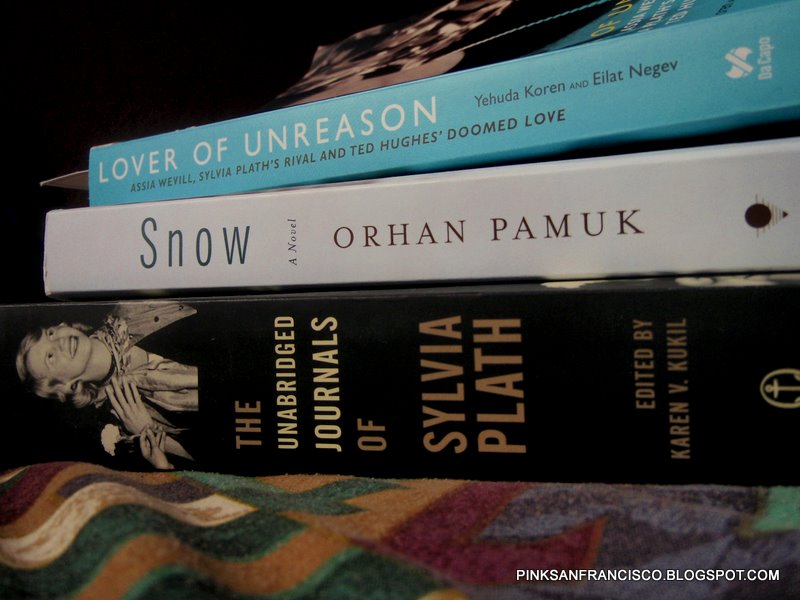
So umm... I went on a shopping spree on Amazon.com and bought three books out of my very long wish list and now the books are here.

Or were here, since I got the books yesterday and I've been reading my first one called Lover of Unreason by Yehuda Koren and Eilat Negev. It's an interesting biography about Assia Wevill, Ted Hughes' other woman in his marriage to Sylvia Plath. Even as a hardcore Plath fan (I'm going to have a bell jar tattooed on my arm this year), I find Assia's character sometimes endearing. I'm on page 73 (of 227 - my God the fonts are small and the book is quite big) now and I just adore how the two authors described Assia's life in a neutral, academic way.

Next up is The Unabridged Journals of Sylvia Plath (edited by Karen V. Kukil). I had no idea that this book would have 675 pages with the same small fonts and relatively same book size with the Assia Wevill one.

Then again, it's Plath. I always have high expectations on her work and she never fails to impress me. And yes, I'm writing in present tense.

The final book will be Snow by Orhan Pamuk. I read My Name is Red years ago and was absolutely smitten by how Pamuk wrote it. I fell in love with him (and found out that he's rather cute - HAHA. This is absolutely not professional or academical whatsoever). I just picked Snow out of the blue. This will be my second Orhan Pamuk, so I don't really know what to expect.